



What we treat
menu-close
WHAT WE TREAT
Weight loss
icon
Testosterone
icon
Hair Loss
icon
Preventive Health
Do health
Do health
Lifestyle programme powered by your biology and blood results
icon
VOY
Meet the experts
icon
Guides
icon
ACCOUNT
Log in
icon
OVERVIEW
Weight loss overview
icon
TREATMENTS
Explore all options
Explore all options
icon
Mounjaro
Mounjaro
Lose up to 23% body weight
icon
Wegovy
Wegovy
Lose up to 21% body weight
icon
Saxenda
Saxenda
Lose up to 10% body weight
icon
Orlos
Orlos
Lose up to 8% body weight
icon
ABOUT
How it works
How it works
icon
App
App
icon
Results
icon
Experts
icon
RESOURCES
Guides & tips
icon
ACCOUNT
Log in
icon
GET IN TOUCH
020 3912 9885
Mon-Fri 9:00-17:30
icon
OVERVIEW
Testosterone overview
icon
ABOUT TRT
How it works & Pricing
icon
Medical Team
icon
CHECK YOUR TESTOSTERONE LEVELS
At-Home Testosterone Blood Test
icon
Enhanced Testosterone Blood Test
icon
REVIEWS
What people say (4.7/5 Trustpilot)
icon
EVERYTHING YOU NEED TO KNOW
Symptoms of low testosterone
icon
What is TRT?
What is TRT?
icon
Benefits of TRT
Benefits of TRT
icon
Normal male testosterone levels
icon
View all articles
icon
ACCOUNT
Log in
icon
SUPPORT
Help Centre
icon
OVERVIEW
Hair Loss overview
icon
Treatments
Complete Hair Loss Plan
icon
Finasteride Plan
icon
Minoxidil Plan
icon
Hair Vitamins
icon
Power Shampoo
icon
EVERYTHING YOU NEED TO KNOW
Topical Dutasteride for hair loss
icon
Finasteride vs Minoxidil
icon
Dutasteride vs Finasteride
icon
Minoxidil - Does it work?
icon
View all articles
icon
ACCOUNT
Log in
icon
SUPPORT
Help Centre
icon
menu-close
WHAT WE TREAT
Weight loss
icon
Testosterone
icon
Hair Loss
icon
Preventive Health
Do health
Do health
Lifestyle programme powered by your biology and blood results
icon
VOY
Meet the experts
icon
Guides
icon
ACCOUNT
Log in
icon
OVERVIEW
Weight loss overview
icon
TREATMENTS
Explore all options
Explore all options
icon
Mounjaro
Mounjaro
Lose up to 23% body weight
icon
Wegovy
Wegovy
Lose up to 21% body weight
icon
Saxenda
Saxenda
Lose up to 10% body weight
icon
Orlos
Orlos
Lose up to 8% body weight
icon
ABOUT
How it works
How it works
icon
App
App
icon
Results
icon
Experts
icon
RESOURCES
Guides & tips
icon
ACCOUNT
Log in
icon
GET IN TOUCH
020 3912 9885
Mon-Fri 9:00-17:30
icon
OVERVIEW
Testosterone overview
icon
ABOUT TRT
How it works & Pricing
icon
Medical Team
icon
CHECK YOUR TESTOSTERONE LEVELS
At-Home Testosterone Blood Test
icon
Enhanced Testosterone Blood Test
icon
REVIEWS
What people say (4.7/5 Trustpilot)
icon
EVERYTHING YOU NEED TO KNOW
Symptoms of low testosterone
icon
What is TRT?
What is TRT?
icon
Benefits of TRT
Benefits of TRT
icon
Normal male testosterone levels
icon
View all articles
icon
ACCOUNT
Log in
icon
SUPPORT
Help Centre
icon
OVERVIEW
Hair Loss overview
icon
Treatments
Complete Hair Loss Plan
icon
Finasteride Plan
icon
Minoxidil Plan
icon
Hair Vitamins
icon
Power Shampoo
icon
EVERYTHING YOU NEED TO KNOW
Topical Dutasteride for hair loss
icon
Finasteride vs Minoxidil
icon
Dutasteride vs Finasteride
icon
Minoxidil - Does it work?
icon
View all articles
icon
ACCOUNT
Log in
icon
SUPPORT
Help Centre
icon
Home/Guides & Tips/Testosterone/

What is testosterone?

TRT

What is testosterone?

Testosterone plays a key role in keeping men feeling physically and mentally at their best. Here’s why this hormone matters.

clinician image

Medically reviewed by Medical Director

Dr. Jeff Foster - Men’s Health & TRT Specialist

iconUpdated 2 March 2026

Testosterone is the main male sex hormone. It’s primarily made in the testes and plays a key role in keeping you physically and mentally well.

So, what’s the function of testosterone and why does it matter? Here’s what to know.

Key takeaways

  • Testosterone is a naturally-occurring steroid hormone.
  • Having balanced testosterone keeps you at your best, physically and mentally.
  • Testosterone is responsible for sperm production, libidio and erectile function.
  • It also impacts your muscle growth, bone density and mood.
  • Low testosterone levels can be treated with testosterone replacement therapy (TRT) medication.
  • You can check your testosterone levels with an at-home blood test.

What does testosterone do?

Testosterone is responsible for the development and function of your male features, from childhood through to puberty and beyond. That includes your reproductive organs growing, your voice deepening, sperm production, libido and erectile function.

But testosterone acts on loads of different systems, too. It regulates your muscle growth, bone density, metabolism and mood, and is linked to cognitive function.
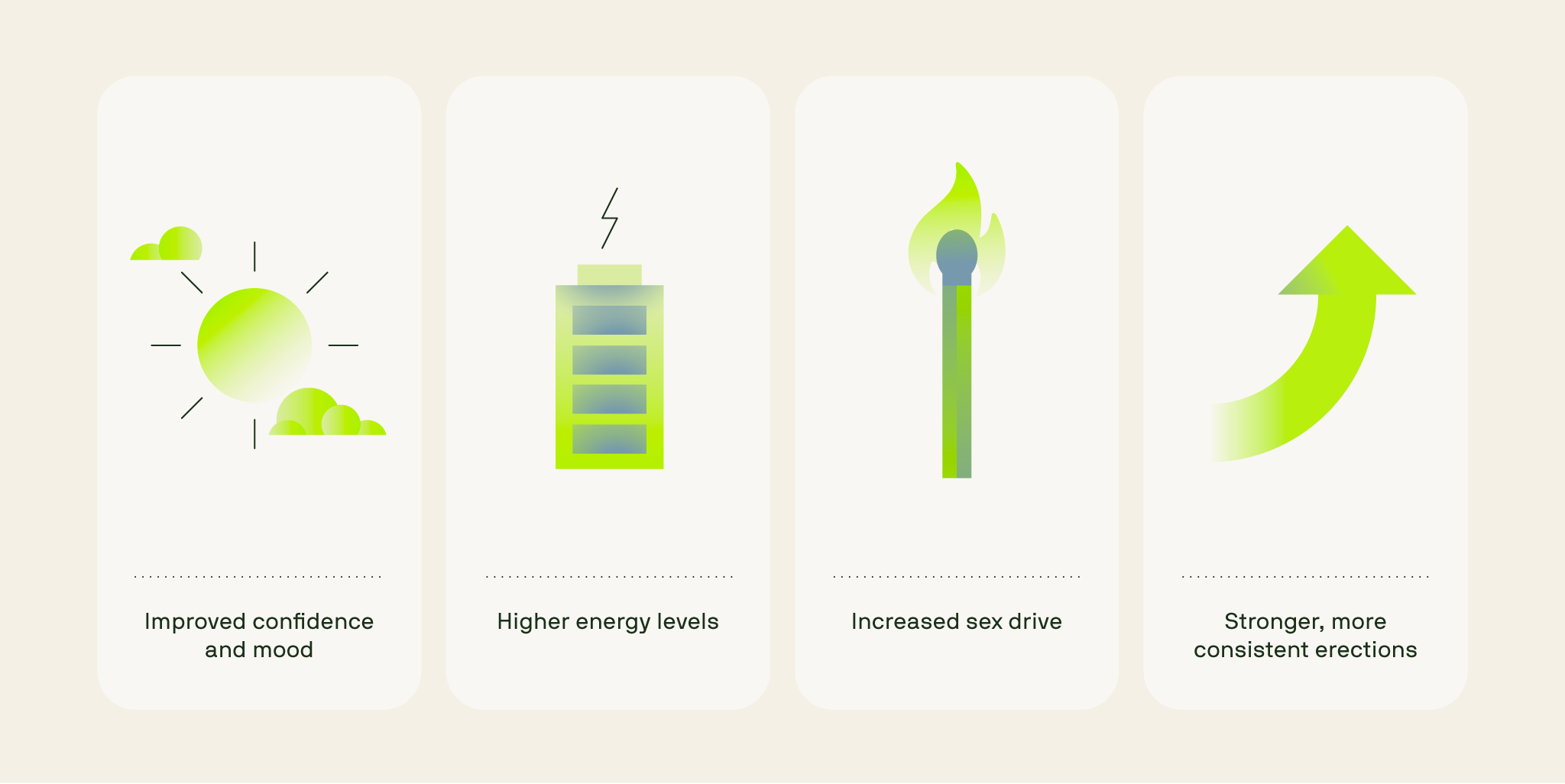
Benefits of testosterone, including improved mood, higher energy, increased sex drive, and erectile function.

Is testosterone a steroid?

Testosterone is a steroid hormone. While the word “steroid” is often linked to performance-enhancing anabolic drugs, testosterone itself is a naturally occurring hormone.

Our guide on testosterone and steroids unpacks how testosterone replacement therapy (TRT) differs from anabolic steroids, and why the two shouldn’t be confused.

How is testosterone measured?

Doctors measure your testosterone levels with a good old-fashioned blood test.

The test is done in the morning before you eat anything. Because testosterone levels can be influenced by different factors, from your diet to stress, you’ll be tested at least twice to confirm you’re actually deficient.

Feeling drained and unfocused?
It might be low testosterone. Get answers fast with an at-home blood test.

Many men also wonder whether habits like masturbation affect their testosterone levels, but research shows it doesn’t.

What are normal levels of testosterone for a man?

Here’s a chart showing average levels of testosterone by age.

Age range
25-34
35-44
45-54
55-64
65-74
75-84
85-100
Av. total testosterone (nmol/l)
21.38
23.14
21.02
19.49
18.15
16.32
13.05
Av. free testosterone (nmol/l)
0.428
0.356
0.314
0.288
0.239
0.207
0.186

The British Society of Sexual Medicine recommends that testosterone replacement therapy (TRT) should be offered to patients with levels below 12nmol/l total testosterone or free testosterone of 0.225nmol/l and below. But you can only usually get TRT on the NHS if your total testosterone levels are less than 8nmol/L (this varies based on your region in the UK).

Low testosterone

Up to 35% of men aged over 45 are estimated to have low T. It’s more common with age: testosterone naturally starts to decline after you turn 30. Not everyone who has low levels of testosterone will have symptoms but majority of men don't know what their baseline is.

Erectile dysfunction, loss of early morning erections and low libido are the three most common. Other include:

  • Reduced energy
  • Depression, anxiety, irritability
  • Reduced strength
  • Reduced enjoyment in life

High testosterone

Having too much testosterone can be a problem, too. It’s not common for men to naturally have abnormally high T, though it can sometimes be caused by underlying medical issues, or use of anabolic steroids. Symptoms include:

  • Acne
  • Prostate enlargement and trouble urinating
  • Risk of clots

It's important to note the goal of testosterone replacement therapy is to normalise low testosterone

Learn more about high testosterone in men—its signs, causes and how to lower it safely.

Types of testosterone

There are two main types of testosterone to be aware of.

Free testosterone

Most testosterone in your blood is attached (or “bound”) to proteins. This T is not active and can’t be put to use in your body. Free tesosterone measures the testosterone that isn't stuck to proteins, that's free to be used by the body.

Total testosterone

This is the overall amount of testosterone in your blood, free and bound. It’s a good first test for low T because it gives a general picture of your hormone levels.

Which forms of testosterone are used for TRT?

Testosterone replacement therapy (TRT) is a synthetic version of T that’s used to treat testosterone deficiency.

But what types of testosterone are used for TRT? Available medicines include:

  • Testosterone undecanoate (tablets or injection, such as Nebido)
  • Testosterone enanthate (injection)
  • Testosterone cypionate (injection)

Each medicine has its pros and cons, and your doctor will advise on what’s best for you. If you’re prescribed injections, understanding how and where to inject testosterone can make the process more comfortable and effective.

Make sure you get TRT from a registered provider (find this information on their website). Otherwise, you can’t guarantee that TRT is safe, authentic or in-date.

Why testosterone matters

Having balanced testosterone keeps you at your best, physically and mentally. And TRT can help get you there.
Take our short quiz and order an at-home, finger-prick blood test to get started. Find out your level.

A stronger, sharper you
Get your energy, drive and strength back, with a tailored testosterone service plan built by leading TRT doctors.
Effective personalised medication
Access to expert clinical team
Regular health monitoring
All-inclusive subscription - no extra costs
FAQ

What is testosterone: FAQs

Continue reading

  • Male menopause (andropause)
  • Benefits of testosterone replacement therapy
  • Testosterone gel for men
  • Enclomiphene citrate
  • Subcutaneous testosterone injections
  • TRT side effects
  • Once you start testosterone therapy, can you stop?
  • Oestradiol levels in men
  • Does ashwagandha increase testosterone?
  • Does nicotine increase testosterone?
  • TRT cost in the UK
  • Men’s health stigma around low testosterone
DisclaimerAt Voy, we ensure that everything you read in our blog is medically reviewed and approved. However, the information provided is not meant to replace professional medical advice, diagnosis, or treatment. It should not be relied upon for specific medical advice.
References
icon¹

Arlt, Wiebke, et al. “Health Status of Adults with Congenital Adrenal Hyperplasia: A Cohort Study of 203 patients,” The Journal of Clinical Endocrinology and Metabolism, vol. 95, no. 11, 2010:5110-5121 https://pmc.ncbi.nlm.nih.gov/articles/PMC3066446/.

icon²

Beauchet, Olivier. “Testosterone and Cognitive Function: Current Clinical Evidence of a Relationship,” European Journal of Endocrinology, vol. 155, issue 6, 2006:773-781 https://academic.oup.com/ejendo/article-abstract/155/6/773/6695703.

icon³

British Society for Sexual Medicine. “A Practical Guide on the Assessment and Management of Testosterone Deficiency in Adult Men.” BSSM.org, 2017 https://bssm.org.uk/wp-content/uploads/2023/02/BSSM-Practical-Guide-High-Res-single-pp-view-final.pdf Accessed 17 September 2025.

icon⁴

Endocrine Society. “Hypogonadism in men.” Endocrine.org, 2022 https://www.endocrine.org/patient-engagement/endocrine-library/hypogonadism Accessed 17 Sept. 2025.

icon⁵

Harvard Health Publishing. “Testosterone: what it is and how it affects your health,” Harvard.edu, https://www.health.harvard.edu/staying-healthy/testosterone--what-it-does-and-doesnt-do Accessed 17 Sept. 2025.

icon⁶

Ishikawa, Toshio, et al. “Aromatase-independent testosterone conversion into estrogenic steroids is inhibited by a 5 alpha-reductase inhibitor,” The Journal of Steroid Biochemistry and Molecular Biology, vol. 98, issues 2-3, 2006:133-138 https://www.sciencedirect.com/science/article/abs/pii/S0960076005004528?via%3Dihub

icon⁷

Nassar, George N., and Leslie, Stephen W. “Physiology, testosterone,” in StatPearls, Treasure Island (FL): StatPearls Publishing 2023 https://www.ncbi.nlm.nih.gov/books/NBK526128/ Accessed 17 Sept. 2025.

icon⁸

National Cancer Institute. “Characteristics of hormones,” SEER Training Modules, National Institutes of Health https://training.seer.cancer.gov/anatomy/endocrine/hormones.html Accessed 17 Sept. 2025.

icon⁹

National Health Service. “Testosterone - chemical pathology.” Gloucestershire Hospitals NHS Foundation Trust https://www.gloshospitals.nhs.uk/our-services/services-we-offer/pathology/tests-and-investigations/testosterone/ Accessed 17 Sept. 2025.

icon¹⁰

National Health Service, “Testosterone Replacement Therapy,” Mersey and West Lancashire Teaching Hospitals NHS Trust, https://sthk.merseywestlancs.nhs.uk/media/.leaflets/6613c78a65e534.75732900.pdf Accessed 17 Sept. 2025.

icon¹¹

National Health Service. “Testosterone Replacement for Men,” Royal United Hospitals Bath NHS Foundation Trust, 2024 https://www.ruh.nhs.uk/patients/patient_information/DIA021_Testosterone_replacement_for_men.pdf Accessed 17 Sept. 2025.

icon¹²

National Health Service. “Testosterone replacement therapy: information for patients”, Kings College Hospital NHS Foundation Trust, 2024 https://www.kch.nhs.uk/wp-content/uploads/2023/01/pl-934.1-testosterone-replacement-therapy.pdf Accessed 17 Sept. 2025.

icon¹³

Rojas-Zambrano, Julio G et al. “Impact of Testosterone on Male Health: A Systematic Review.” Cureus, vol. 17, no. 4, 2025:e82917 https://pmc.ncbi.nlm.nih.gov/articles/PMC12023631/.

icon¹⁴

Shea, Jennifer L, et al. “Free Testosterone: Clinical Utility and Important Analytical Aspects of Measurement,” Advances in Clinical Chemistry, vol. 63, 2014:59-84 https://www.sciencedirect.com/science/article/abs/pii/B9780128000946000029?via%3Dihub.

icon¹⁵

Vermeulen, A. “Declining Androgens with Age: An Overview.” In Vermeulen, A. & Oddens, & B.J. (Eds.), Androgens and the Aging Male (pp. 3-14). New York: Parthenon Publishing. 1996.

Related articles

card-image
Testosterone
What is testosterone cypionate?
Here’s everything you need to know about testosterone cypionate.
card-image
Testosterone
Anadrol (oxymetholone)
Here’s everything you need to know about Anadrol and why you shouldn’t take it to treat low T.
card-image
Testosterone
What is tadalafil?
Tadalafil treats erectile dysfunction. Here’s how it works and where to get it.
Have a question?
phone icon
020 3912 9885Monday - Friday 9am - 5pm
support icon
help@joinvoy.comWe aim to reply in 24hrs
email icon
press@joinvoy.comPress & media inquiries
Our services are not intended for use in a medical emergency. If you need urgent medical attention, please call 111 or 999.

Women

  • Weight Loss
  • Menopause

Men

  • Hair Loss
  • Weight Loss
  • Testosterone

Prevention

  • Do Health

Voy

  • Meet the experts
  • Sitemap
  • Careers

Legal

  • Privacy policy
  • Terms & Conditions
  • Terms of Sale
  • Complaints

Get help

  • Help Centre (FAQ)
facebooktwitterinstagram
Copyright 2026 Voy. All rights reserved.
Pharmacies: Manual PharmacySuperintendent Pharmacist: Dawn NeilGPhC Registration: 2063362
registered pharmacycqc ratingcpd member