
















































 ¹
¹Johnson, Hans, et al. "Digital Engagement Enhances Dual GIP/GLP-1 Receptor Agonist and GLP-1 Receptor Agonist Efficacy: A Retrospective Cohort Analysis of a Digital Weight Loss Service on Outcomes and Safety." Diabetes, Obesity and Metabolism, 27 Oct. 2025, https://doi.org/10.1111/dom.70244.
How does Wegovy work in the body for weight loss?
Wegovy works by mimicking a natural gut hormone called GLP-1 that your body produces when you eat. Understanding what GLP-1 does helps explain why Wegovy is so effective for weight loss.
What is GLP-1?
GLP-1 (glucagon-like peptide-1) is a hormone your gut releases naturally when you eat. It's one of the main ways your body regulates hunger and fullness.
When GLP-1 enters your bloodstream, it creates three key effects that support weight loss:
Controls your appetite: GLP-1 signals to your brain that you've eaten enough. This helps you feel satisfied with smaller meals and reduces cravings between meals.
Keeps you fuller for longer: GLP-1 slows down how quickly food leaves your stomach. Instead of feeling hungry again an hour after eating, you stay satisfied for much longer.
Helps manage blood sugar: GLP-1 helps your body handle the sugar from your meals more effectively, preventing energy crashes and the hunger that often follows.
Your body's natural GLP-1 breaks down within minutes of being released. Wegovy is engineered to last much longer, about a week after each injection. This extended activity means you experience consistent appetite suppression and blood sugar control between doses, rather than the brief effects your body's natural GLP-1 provides.
Other weight loss medications work through the same GLP-1 pathway, including Mounjaro and Saxenda. Mounjaro also activates a second hormone called GIP alongside GLP-1.
Is Wegovy licensed and prescribed in the UK?
Yes, Wegovy is fully licensed in the UK by the Medicines and Healthcare products Regulatory Agency (MHRA). The medication received approval for weight management in 2021 and became available in the UK in 2023. In July 2024, regulators extended its license to include cardiovascular risk reduction in adults with established cardiovascular disease.
This dual licensing means doctors and healthcare professionals can legally prescribe Wegovy in the UK through the NHS or private services for both weight loss and reducing the risk of serious cardiovascular events like heart attacks and strokes.
Can you get Wegovy on the NHS?
Wegovy is available on the NHS, but only through specialist weight management services.To be referred to a specialist weight management service for Wegovy, you need:
- A BMI of 35 or more (or 32.5 or more if you're of Asian, Chinese, Middle Eastern, Black African or African-Caribbean origin), OR
- A BMI of 30 to 34.9 (or 27.5 to 32.4 for the ethnicities above) and you meet additional criteria for specialist weight management services
In reality, most people who would benefit from Wegovy either don't meet these strict NHS criteria or face long waiting lists for specialist weight management services, which is why the majority of patients access treatment through private providers like Voy.
What results can you expect with Wegovy?
Wegovy has been clinically proven to deliver significant weight loss results. The 7.2mg dose has demonstrated up to 20.7% weight loss in clinical trials.
These results show what's possible with Wegovy, but your individual outcome will depend on several factors:
Diet and nutrition: Wegovy works best when you maintain a calorie deficit with adequate protein intake to preserve muscle mass
Physical activity: Regular movement and exercise accelerate weight loss and help maintain your results
Consistency: Taking your weekly injection on schedule without missing doses or taking breaks
Side effect management: Working with your clinical team to handle any side effects so you can stay on treatment
Dose and treatment duration: Higher doses and longer time on treatment generally produce greater weight loss
Individual biology: Your metabolic rate, medical history, other medications, and how your body responds to treatment
Other benefits of Wegovy beyond weight loss
While most people seek Wegovy for weight loss, the medication delivers several additional health benefits that may be equally important for your long-term wellbeing.
Cardiovascular protection
Wegovy holds unique status as the only weight loss medication licensed specifically to reduce cardiovascular risk.
In a large clinical trial of over 17,600 people with heart disease, Wegovy reduced the risk of heart attacks, strokes, and cardiovascular death by 20%.
Who gains most from Wegovy's cardiovascular protection:
- People with a history of heart attack or stroke
- Adults with diagnosed cardiovascular disease
- Individuals with multiple cardiovascular risk factors like high blood pressure, high cholesterol, and obesity
- Anyone concerned about their heart health alongside weight management
If cardiovascular protection matters to you, Wegovy may be particularly well-suited to your needs.
Blood sugar control
Wegovy delivers powerful blood sugar improvements, even though it isn't licensed for type 2 diabetes treatment. Ozempic, which contains the same active ingredient semaglutide, is the version licensed for diabetes.
Wegovy helps manage blood sugar through several mechanisms:
- Stimulating the pancreas to release more insulin after you eat, helping to regulate blood sugar levels
- Suppressing glucagon (a hormone that raises blood sugar), which reduces glucose production in the liver
- Slowing stomach emptying, which stops sudden spikes in blood sugar after meals
- Improving insulin sensitivity (particularly as weight decreases)
What about prediabetes?
Wegovy is not licensed for prediabetes, but if you have prediabetes and qualify for weight loss treatment, doctors can prescribe it.
Weight reduction represents one of the most powerful interventions for reversing prediabetes and preventing its progression to type 2 diabetes. Wegovy's direct blood sugar improvements add extra metabolic benefits beyond weight loss alone.
PCOS (Polycystic Ovary Syndrome)
Wegovy isn't licensed to treat PCOS, but women with PCOS who qualify for weight loss treatment can be prescribed it.
PCOS creates a self-reinforcing cycle where insulin resistance makes weight loss extremely difficult, while excess weight worsens insulin resistance. Breaking this cycle through weight loss of just 5% or more can:
- Restore regular menstrual cycles
- Improve fertility and ovulation
- Reduce insulin resistance
- Lower testosterone levels that cause unwanted symptoms
Wegovy attacks this cycle from both angles by promoting weight loss while simultaneously improving insulin sensitivity.
Wegovy doses and titration schedule
Wegovy follows a careful dose escalation schedule, beginning at a minimal dose and gradually increasing over several months. This titration approach allows your body to adapt to the medication progressively, minimising side effects while building toward maximum weight loss effectiveness.
The standard Wegovy progression follows this timeline, assuming good tolerance at each stage:
- Weeks 1-4: 0.25mg once weekly
- Weeks 5-8: 0.5mg once weekly
- Weeks 9-12: 1mg once weekly
- Weeks 13-16: 1.7mg once weekly
- Weeks 17-20: 2.4mg once weekly
- Week 21 onwards: 7.2mg once weekly
Your individual journey may differ from this standard schedule.
Finding your optimal dose means identifying the level that delivers strong appetite suppression, consistent weight loss, and tolerable side effects. Many people reach their ideal dose at 0.5mg, 1mg, or 1.7mg and continue at that level without needing to progress to 2.4mg or 7.2mg.
When your pace might differ:
Your clinician may suggest extending the time at your current dose beyond 4 weeks, or even temporarily reducing your dose if side effects become challenging. You might also decide to remain at a particular dose if you're achieving excellent results and adequate appetite suppression.
Your Voy clinical team will work with you to determine the right progression pace and final dose for your circumstances.
Can you start at a higher dose?
Standard practice starts everyone at 0.25mg, the lowest available dose. This approach has important benefits:
- Side effect reduction: Beginning low gives your digestive system time to adapt to how Wegovy affects gastric emptying. Starting at a higher dose dramatically increases your risk of severe nausea and vomiting.
- Improved persistence: Gradual dose increases lead to fewer treatment interruptions due to side effects, resulting in more consistent medication use and superior long-term weight loss.
- Safe medication build-up: Wegovy requires 4-5 weeks to reach stable levels in your bloodstream. Starting at the lowest dose ensures this build-up happens safely.
Can I start at a higher dose if I'm switching from another medication?
If you're switching to Wegovy from a different GLP-1 medication like Mounjaro, you may qualify to start at a higher dose rather than beginning at 0.25mg. This helps you maintain your progress during the transition.
Such prescribing is considered off-label. At Voy, our clinicians evaluate your treatment history and apply current evidence to recommend the dose that enables safe, effective continuation of your weight loss journey.
Can you remain on 0.25mg?
Yes, if you're experiencing adequate appetite control and satisfactory weight loss, you can remain at 0.25mg. However, this dose serves primarily as an initiation dose designed to help your body adjust while minimising side effects.
Over time, your body typically adapts to the dose, which means the appetite suppression and weight loss effects gradually weaken. This adaptation explains why most people eventually need dose increases to continue seeing results.
Once you've reached your goal weight, some people step back down to 0.25mg as a maintenance dose to help keep the weight off.
Wegovy 7.2mg: Now Available
A higher-dose formulation of Wegovy has been approved in the UK and is now available for prescription.
What is Wegovy 7.2mg?
Wegovy 7.2mg is the new highest dose available, three times stronger than the 2.4mg dose.
In the STEP UP clinical trial, published in January 2025, participants using Wegovy 7.2mg achieved:
- 20.7% average weight loss at 72 weeks
- A side effect profile comparable to the 2.4mg dose
Who is Wegovy 7.2mg for?
The 7.2mg formulation targets people who:
- Have reached the current 2.4mg maximum dose but haven't achieved their weight loss targets on the current maximum dose
- Tolerate the 2.4mg dose well with little to no side effects
The 7.2mg dose won't be necessary or appropriate for everyone. Many people achieve excellent results on lower doses without needing to increase further.
If you're currently taking Wegovy and interested in the 7.2mg option, speak to your Voy clinical team about whether it might be suitable for you.
What to expect week by week on Wegovy
Everyone responds to Wegovy differently, but here's a typical progression as your body adapts to the medication and your dose increases over time.
Weeks 1-4: Getting started
What's happening: You'll typically start at 0.25mg, the lowest dose. If you're switching from another weight loss injection like Mounjaro, you may be able to start higher depending on your treatment background.
The first month is about allowing your body to adjust to the medication rather than producing dramatic weight loss.
What you might experience:
- Reduced appetite and fewer cravings (though some people don't notice much change yet)
- Mild digestive changes like nausea, diarrhoea, and constipation.
Typical weight loss: Around 2% of your starting weight by week 4.
Focus areas: Establish consistent routines like injecting on the same weekday, eating balanced meals, and maintaining good hydration. Side effects at this dose are usually mild and improve within a few weeks. Contact your clinical team if they're troublesome.
Weeks 5-8: Appetite control improves
What's happening: Most people increase to 0.5mg at week 5. This is often when you'll notice stronger appetite suppression and weight loss picks up pace.
What you might experience:
- Noticeably less hunger throughout the day
- Feeling full with smaller meal portions
- Side effects may briefly increase after the dose change but usually settle within 1-2 weeks
Typical weight loss: Around 4% of your starting weight by week 8.
Focus areas: Continue developing healthy habits around food and exercise. These habits become crucial for maintaining your weight loss long-term, even after stopping Wegovy.
Weeks 9-12 and beyond: Steady progress
What's happening: You may increase to 1mg around week 9 if you're tolerating the medication well. By 12 weeks, you should be seeing consistent weight loss.
What you might experience:
- Continuous monthly weight loss
- Healthier eating feeling more effortless and natural
- Improved energy and easier movement
Typical weight loss: Around 6% of your starting weight by week 12.
Long-term outcomes: Clinical trials show an average of 17.5% weight loss at 72 weeks on the 2.4mg dose. The new 7.2mg dose showed 20.7% weight loss at 72 weeks.
Focus areas: Stay consistent with your weekly injections, maintain balanced nutrition, and keep active. Most people take Wegovy for at least a year to reach their goals and maintain their results.
What is a weight loss plateau?
A weight loss plateau occurs when your weight remains unchanged for several weeks (typically 3-4 weeks or longer), despite maintaining consistency with Wegovy and your healthy habits. Plateaus are a normal part of nearly everyone's weight loss journey.
It's important to distinguish genuine plateaus from the natural slowing that occurs after the initial weeks of treatment. Weight loss is often faster at the beginning, then settles into a steadier pace. A true plateau means progress has completely stalled for an extended period.
The good news is that a few lifestyle tweaks can often break through a plateau and get your weight loss moving again.
Why does weight loss plateau on Wegovy?
Several factors can cause plateaus:
Dose adaptation: If you've been on the same dose for a while, your body may have adapted to it. The appetite suppression you initially experienced can gradually diminish.
Metabolic adjustment: Weight loss reduces your body's calorie requirements. The calorie intake that created a deficit earlier in your journey may now be closer to maintenance levels.
Lifestyle drift: Sleep quality, stress levels, daily activity, and hydration all influence weight loss. Small reductions in daily movement (like walking fewer steps) can eliminate the calorie deficit you previously maintained.
Muscle development: If you've increased physical activity, particularly strength training, you might be building muscle while losing fat. Since muscle is denser than fat, the scale may stay constant even though your body composition is improving.
Natural adaptation to restriction: Extended periods of calorie restriction can cause your body to conserve energy more aggressively, reducing the rate at which you burn calories.
Medical conditions: Conditions including PCOS, thyroid disorders, or hormonal imbalances can complicate weight loss. If you suspect an underlying medical factor, discuss this with your clinician.
How to break through a Wegovy weight loss plateau
Most plateaus can be broken by reviewing a few key areas:
Review your diet and portions:
- Are you still maintaining a calorie deficit? Weight loss reduces your calorie needs
- Are you consuming adequate protein? Target 1.2-1.6g per kg of body weight daily
- Have portions gradually increased without you noticing?
Check your activity levels:
- Have your daily steps declined?
- Are you including strength training? Target at least two sessions weekly to maintain muscle mass
- Has your exercise consistency dropped?
Look at sleep, stress, and hydration:
- Both poor sleep and chronic stress can interfere with weight loss
- Ensure you're drinking adequate water throughout the day
Consider a dose increase:
If you've addressed the fundamentals and implemented changes but still haven't seen progress after 4-6 weeks, discuss increasing your dose with your clinician. You may be ready for a dose increase if:
- You've remained on the current dose for 4+ weeks
- Your appetite suppression has weakened
- Side effects are well-controlled
Your Voy clinical team can help you identify which areas to focus on and determine if a dose increase is right for you.
How to use Wegovy
How often is Wegovy injected?
Wegovy requires one injection per week, administered on the same day each week. Choose a day that fits your routine and set a phone reminder to help you stay consistent.
Can you change your Wegovy injection day?
Yes, but you must leave at least 3 days (72 hours) between doses.
Taking your injection early increases the risk of side effects, so only do this if you're tolerating your current dose well.
Try to keep changes to a minimum. Changing your injection day frequently can disrupt stable medication levels and make side effects worse. Once you pick a new day, stick to it.
How many doses are in a Wegovy pen?
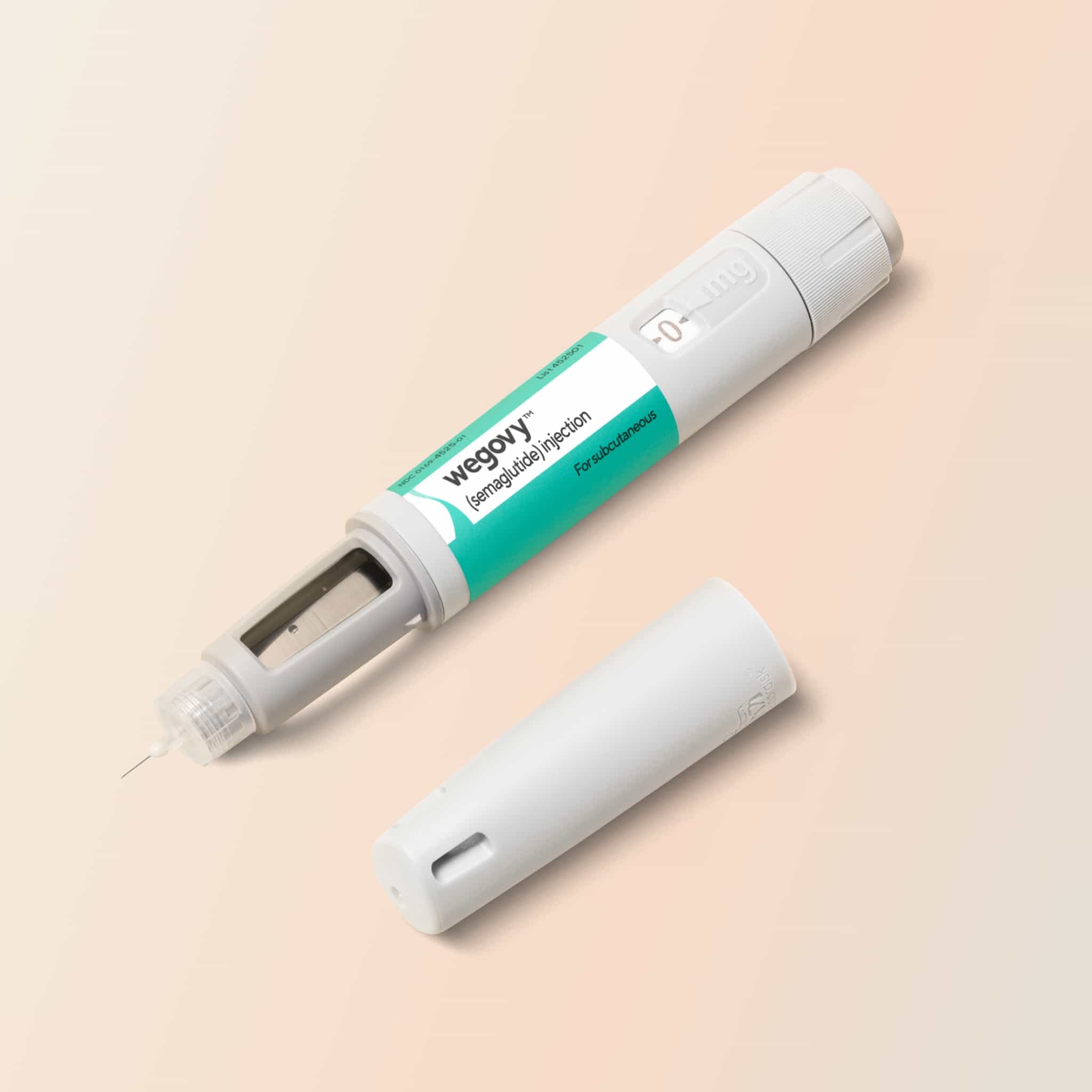
Each Wegovy pen contains four doses, one for every week. You use the same pen for four weekly injections, attaching a fresh needle each time.
Where to inject Wegovy
Wegovy is a subcutaneous injection, administered into the fatty tissue just beneath your skin.
You can inject Wegovy in three areas:
- Stomach (abdomen): At least 5cm (2 inches) from your belly button. This is the most popular injection site as it's easy to reach.
- Front of your thighs: The upper, outer part of your thighs.
- Upper arm: The back or outer area of your upper arm. You may need someone else to help you inject in this area.
Injection sites to avoid:
- Within 5cm of your belly button
- Scar tissue, moles, birthmarks, or tattoos
- Bruised, tender, swollen, or red skin
- Stretch marks or sunburned areas
- Varicose veins
Why site rotation matters:
Use a different spot each week, even if you stay within the same general area (like your abdomen). Repeatedly injecting the exact same spot can cause skin thickening or hardening, which impairs medication absorption and may cause discomfort.
How to inject Wegovy: Step-by-step
What you'll need:
- Your Wegovy pen
- A new needle
- Sharps disposal container
Before you start:
- Wash your hands thoroughly with soap and water
- Check the pen: Make sure it's in date, not damaged, and the liquid is clear and colourless (not cloudy or discoloured)
- If stored in the fridge, you can let the pen sit at room temperature for 15 minutes (this can make the injection more comfortable)
Preparing the pen:
- Remove the pen cap
- Attach a new needle: Remove the paper tab, push the needle straight onto the pen, and twist until secure
- Remove both needle caps (outer and inner). Keep the outer cap as you will need it later
Checking the flow (only do this once when you first use a new pen):
- Turn the dose selector until the flow check symbol appears
Hold the pen with the needle pointing upward - Press and hold the dose button until the dose counter shows 0
A drop of medication should appear at the needle tip. This drop indicates that your pen is ready for use. - You don't need to do the flow check for your 2nd, 3rd, or 4th injection with the same pen.
Injecting:
- Select your dose by turning the dose selector until your prescribed dose appears
- Insert the needle straight into your skin at a 90-degree angle
- Press and hold the dose button until the dose counter shows 0
- Continue holding for at least 6 seconds to ensure the full dose is delivered
- Remove the needle from your skin
After injecting:
- A small drop of blood is normal. Gently press with a cotton ball if needed (don't rub)
- Carefully replace the outer needle cap
- Unscrew the needle and immediately dispose of it in a sharps container
- Replace the pen cap
How to store Wegovy
Proper storage maintains Wegovy's effectiveness and safety.
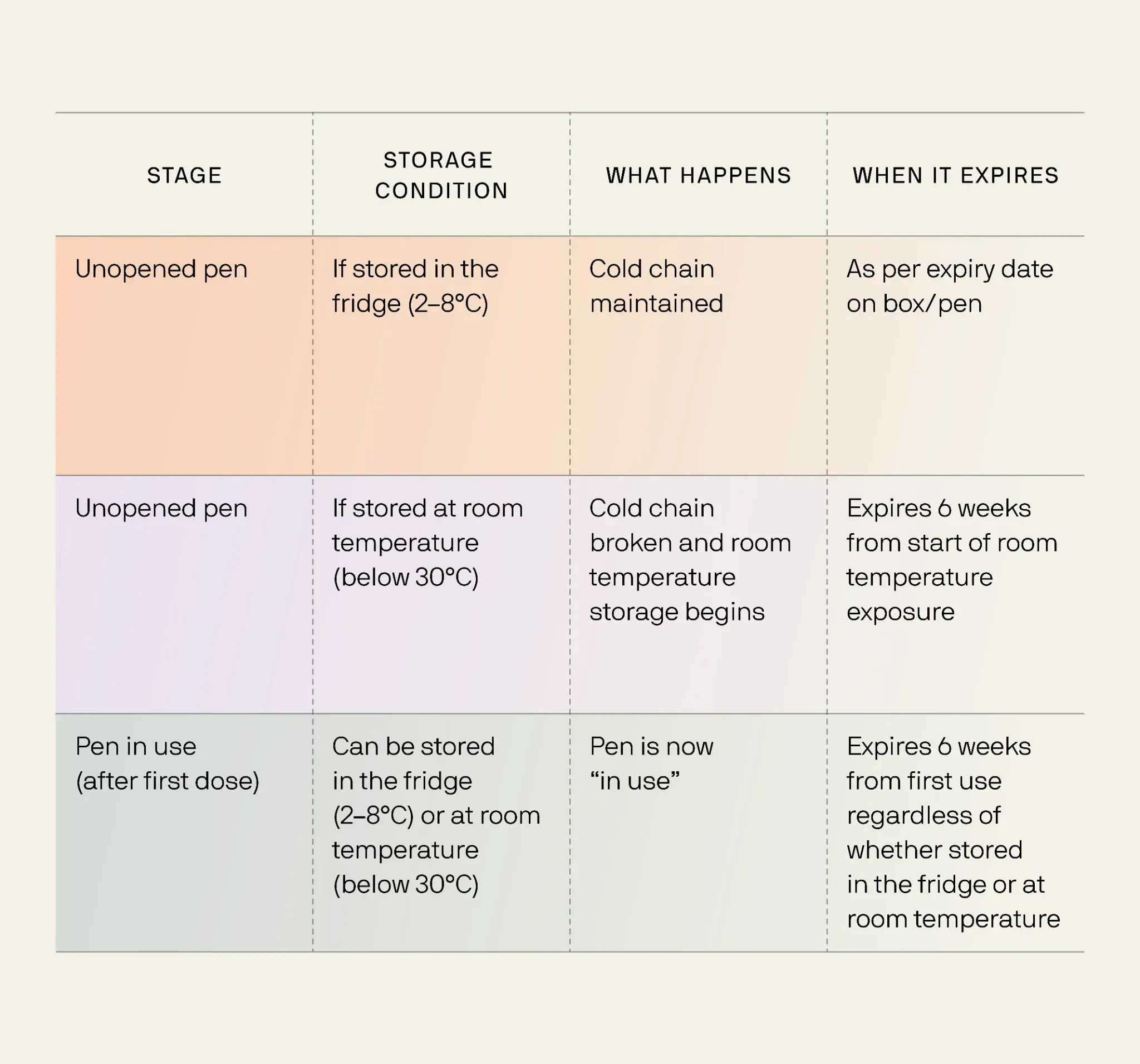
Storing unopened pens:
- Keep refrigerated at 2-8°C
- Store in original packaging to protect from light
- Avoid storing in the fridge door (temperature fluctuates excessively)
- Never freeze Wegovy. If frozen, discard it
Storing opened pens:
- Can be kept refrigerated (2-8°C) OR at room temperature (below 30°C) for up to 6 weeks
- Keep away from direct sunlight and heat
- Store with the pen cap on
- Store out of children's reach
How long does the Wegovy pen last?
Unopened pens:
- Refrigerated: Until the expiry date printed on the box
- At room temperature: 6 weeks.
Once opened:
- 6 weeks maximum, whether refrigerated or at room temperature
- Set a reminder when you first use your pen to avoid using it beyond the 6-week limit
When to discard Wegovy:
- It's past the expiry date
- It's been opened for more than 6 weeks
- It's been exposed to temperatures exceeding 30°C
- It's been frozen
- The liquid appears cloudy, discoloured, or contains particles
How long do you need to take Wegovy?
Most people use Wegovy for a minimum of one year, with many continuing long-term on a lower dose to maintain their results.
Clinical trials show that people continue to lose weight throughout the first 72 weeks (around 16 months) of treatment. At the 7.2mg dose, participants lost an average of 20.7% of their starting weight at 72 weeks.
How long you need to take Wegovy depends on:
- Your starting weight and how much weight you want to lose
- Your broader health goals, such as cardiovascular protection or blood sugar control
- Whether you plan to continue on a maintenance dose or stop after reaching your target weight
Why long-term treatment is important:
Weight loss medication works best when combined with lasting lifestyle changes. Taking Wegovy long-term gives you time to build sustainable habits around food and activity that will help you maintain your results after stopping or transitioning to a lower maintenance dose.
At Voy, we support you throughout your journey to help you develop the habits that keep the weight off for good.
What is the maintenance dose?
Your maintenance dose is the dose that keeps your weight stable once you've hit your target. The goal is to stop active weight loss without regaining what you've lost.
At Voy, maintenance doses are personalised based on your individual response. Some people find their sweet spot at 0.5mg or 1mg, while others need 1.7mg or 2.4mg to maintain their results. The right maintenance dose for you:
- Controls your appetite enough to prevent weight regain
- Doesn't cause ongoing weight loss
- Produces minimal side effects
- Supports your overall health goals
Your Voy clinical team helps you identify when you're ready to transition to maintenance and finds the dose that works best for keeping the weight off long-term.
Wegovy side effects
Side effects can occur with Wegovy, but they vary from person to person. Most are mild and temporary, fading within a few weeks as your body gets used to the medication.
At Voy, fewer than 1% of patients stop treatment because of side effects. With the right support, most people manage any symptoms successfully.
What are the most common Wegovy side effects?
Digestive symptoms are the most common side effects with Wegovy. They tend to appear when you first start the medication or move up to a higher dose.
Very common side effects (may affect more than 1 in 10 people):
- Headache
- Feeling sick (nausea)
- Being sick (vomiting)
- Diarrhoea
- Constipation
- Stomach discomfort
- Feeling tired.
Common side effects (may affect up to 1 in 10 people):
- Indigestion
- Dizziness
- Burping
- Gas or bloating
- Acid reflux or heartburn
- Hair loss (usually temporary)
- Low blood sugar (hypoglycaemia), particularly if taking other diabetes medications
Side effects support at Voy
If you're struggling with symptoms, call our support line on 020 3912 9885 and press 2 to speak to a clinician within minutes (Monday to Friday, 9 AM to 5 PM).
Your Voy clinical team can:
- Offer guidance on symptom management
- Prescribe treatments to alleviate side effects
- Adjust your dose to achieve the right balance
Who should not take Wegovy?
Wegovy isn't suitable for everyone. You shouldn't use it if any of the following apply to you:
- You're under 18
- You're pregnant, breastfeeding, or planning to get pregnant
- You're allergic to semaglutide or other ingredients in Wegovy
- You have type 1 diabetes
- You have a personal or family history of medullary thyroid carcinoma (MTC)
- You have Multiple Endocrine Neoplasia syndrome type 2 (MEN 2)
- You have severe digestive conditions like Crohn's disease, ulcerative colitis, or gastroparesis
- You've had pancreatitis (inflammation of the pancreas)
- You have severe kidney or liver disease
- You have gallbladder issues (unless it's been surgically removed)
- You have diabetic retinopathy (diabetes-related eye damage)
Medications that may interact with Wegovy
Other weight loss medications: Do not combine Wegovy with other weight loss injections (like Mounjaro or Saxenda) or orlistat. Combining multiple weight loss medications is unsafe and not recommended.
Diabetes medications: Wegovy can interact with insulin and sulfonylureas (like gliclazide), raising the risk of dangerously low blood sugar.
Other medications: Because Wegovy slows stomach emptying, it may affect how your body absorbs other oral medications. Tell your clinician about all medications you're taking, including over-the-counter drugs and supplements.
What foods should you avoid on Wegovy?
No foods interact directly with Wegovy, but some can make side effects worse or slow down your progress.
Foods that trigger side effects:
Fatty and greasy foods (takeaways, fried meals, rich sauces, pastries) can trigger nausea, diarrhoea and stomach discomfort. Spicy foods may aggravate your stomach, particularly if you're already experiencing nausea or indigestion.
Foods that hinder weight loss:
High-sugar foods like sweets, biscuits, cakes, and fizzy drinks trigger blood sugar spikes and provide empty calories without keeping you full.
Ultra-processed foods like ready meals, crisps, and processed meats are high in calories and unhealthy fats but low in the nutrients your body needs for healthy weight loss.
Better choices:
Build meals around protein (meat, fish, eggs, beans), vegetables, and whole grains. Include healthy fats from sources like olive oil, avocado, and nuts. These keep you satisfied longer and are easier on your stomach.
Find your triggers:
Everyone reacts differently. Track what you eat and any symptoms you notice in the first few weeks. This helps you work out which specific foods don't agree with you on Wegovy.
Can you drink alcohol on Wegovy?
Alcohol isn't forbidden on Wegovy, but it's best to limit it or skip it altogether.
Why cutting back helps:
- Drinking can trigger digestive side effects like nausea and vomiting, especially in your first few weeks or after increasing your dose.
- Alcohol adds calories without any nutritional benefit, which works against your weight loss goals.
- If you have type 2 diabetes, there's an added risk. Alcohol can cause your blood sugar to drop too low, particularly when combined with other diabetes medications.
If you choose to drink:
- Avoid alcohol during the initial weeks of treatment and during the week following each dose increase while your body adapts to the medication
- Save drinking for occasional events rather than making it a regular habit
- Opt for lower-calorie choices: a spirit with diet mixer or a glass of dry wine instead of a pint of beer or a sugary cocktail
- Always alternate alcoholic drinks with water to stay hydrated